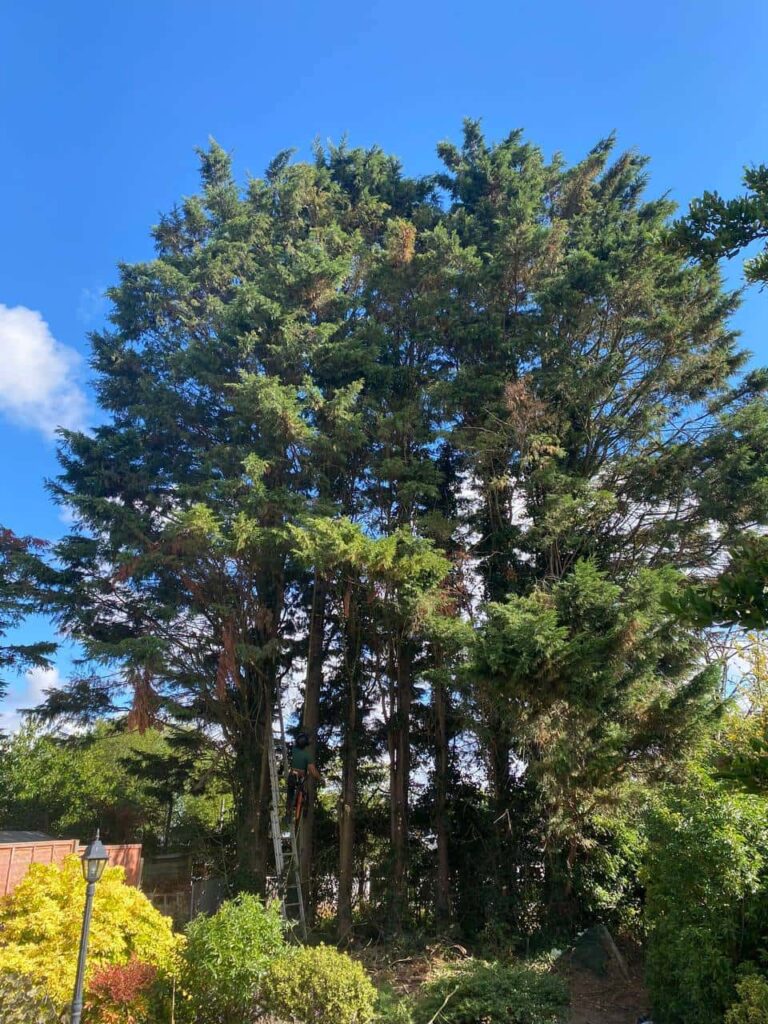
Trees do not need constant cutting, but they do benefit from appropriate management as they mature. Without periodic assessment and selective pruning, branches can become overcrowded, excessively long or structurally weak. This may affect the tree’s health, stability and suitability for its surroundings.
For property owners in Sudbury, Suffolk, recognising the signs of neglected growth can help ensure that suitable work is completed before the tree becomes more difficult to manage.
Recognising When a Tree Needs Professional Pruning
The need for pruning should be based on the condition and structure of the individual tree rather than a fixed schedule. Species, age, location and previous maintenance all influence how quickly attention may be required.
A professional assessment can determine whether selective branch removal, crown thinning, crown lifting or crown reduction is the most appropriate approach.
Dead Branches Are Building Up in the Crown
Deadwood is one of the clearest signs that a tree requires attention. Dead branches may be bare when the surrounding crown is in leaf, have peeling bark or show no flexible growth at their tips.
As deadwood deteriorates, branches can become increasingly likely to break away. Removing them also makes it easier to inspect the remaining crown and identify other structural concerns.
Not every dead twig requires intervention, but larger branches or substantial accumulations should be professionally assessed.
Branches Are Crossing and Rubbing Together
Overcrowded crowns often contain branches growing across one another. Repeated movement can cause their bark to rub away, creating wounds and weakening both branches.
Selective pruning can remove the less suitable branch while retaining the one that contributes more effectively to the tree’s structure. Addressing crossing growth before the branches become large usually allows for smaller, more precise cuts.
The Crown Has Become Excessively Dense
A dense crown can contain congested shoots, poorly positioned branches and competing growth. It may also make the tree appear heavy or unbalanced.
Careful crown thinning can remove selected branches while preserving the tree’s overall size and natural form. This should not involve stripping out large areas or leaving isolated branches around the edge of the crown.
Appropriate pruning aims to improve branch distribution without removing more living growth than necessary.
Branches Are Becoming Too Long and Heavy
Branches that extend a considerable distance from the main trunk can place increasing leverage on their attachment points. The concern may be greater when limbs carry substantial foliage, grow mostly towards one side or have weak unions.
Reducing selected branch lengths can help improve balance and lessen mechanical strain. The cuts must be positioned correctly so the remaining branch can continue developing naturally.
Growth Is Obstructing Access or Reaching Structures
A tree may have been left too long without pruning when branches begin interfering with:
- Paths, driveways or garden access
- Roofs, walls and windows
- Sheds and other garden structures
- Entrances or frequently used outdoor areas
- Nearby plants that need adequate growing space
Early pruning can often restore suitable clearance without significantly altering the tree. Waiting until branches are much larger may require more extensive work and leave larger pruning wounds.
The Tree Has Developed an Uneven Shape
Trees adapt to their surroundings and do not need to be perfectly symmetrical. However, pronounced one-sided growth can result in an uneven distribution of weight.
This may occur when branches grow towards available light, previous cuts stimulate growth in one area or part of the crown becomes damaged. Selective pruning can sometimes improve balance, although substantial corrections may need to be completed gradually.
The purpose should be to support sound structure rather than force the tree into an artificial shape.
Weak Shoots Have Appeared After Earlier Cutting
Poorly planned or overly severe cutting can trigger dense clusters of fast-growing shoots. These shoots may be weakly attached and can quickly make the crown congested again.
If vigorous regrowth has been left unmanaged, repeated cutting without a clear plan may make the problem worse. A tree surgeon can assess which shoots should be retained, shortened or removed to develop a more stable branch arrangement.
Split Branches or Weak Unions Are Visible
Forks with narrow angles, included bark or visible cracks can become points of weakness as adjoining stems increase in size and weight. Long periods without assessment may allow these defects to develop unnoticed.
Pruning may be used to reduce weight on a vulnerable section or remove an unsuitable branch. The correct response depends on the position, extent and significance of the defect, so the tree should be inspected before work is recommended.
The Tree Has Outgrown Its Available Space
A tree may remain healthy while becoming unsuitable for the space it occupies. Its crown might dominate a small garden, extend beyond manageable boundaries or repeatedly interfere with surrounding features.
Professional pruning can control selected growth while retaining the tree’s natural proportions. Crown reduction may sometimes be appropriate, but excessive removal should be avoided because it can stress the tree and produce weak regrowth.
Why Delayed Pruning Can Make the Work More Complex
Pruning smaller branches generally creates smaller wounds and allows growth to be directed more precisely. When unsuitable branches are allowed to mature, their eventual removal can have a greater effect on the tree.
Delayed attention can also allow several issues to develop at once. Deadwood, crossing branches, uneven growth and restricted clearance may then need to be addressed as part of a carefully planned programme.
Conclusion
Signs that a tree has been left too long without pruning include deadwood, crossing branches, an overcrowded crown, excessively extended limbs and growth interfering with nearby features. Weak regrowth, visible splits and pronounced imbalance can also indicate that professional attention is needed.
Sudbury Tree Surgeons provides professional tree pruning and maintenance throughout Sudbury, Suffolk. If you are concerned about an overgrown or neglected tree, contact us to arrange an assessment and receive practical guidance on the most suitable work.
Call us on: 01787 322 388
Click here to find out more about Sudbury Tree Surgeons
Click here to complete our contact form and see how we can help with your tree needs.